![[S2S] After-sun Care - Stream2Sea](http://stream2sea.com/cdn/shop/collections/SPF30_and_Sun_Sting_Gel.jpg?v=1780532294&width=1500)


A follow-up to our earlier piece, Is Bemotrizinol Really a Safer Sunscreen Filter? What You Should Know Before Trusting It.

When we first wrote about bemotrizinol, it was an ingredient waiting in line for FDA review and we said the same thing we always say: show us the data first, for people and for the planet.
Well, part of that data came in. On June 9, 2026, the FDA made it official. So we want to walk you through what actually happened, what it means, and just as importantly, what it does not mean. Here are the four things we think every water lover should understand, minus the hype.
1. It is the first new sunscreen filter the FDA has approved in about 25 years
This is real news, and it is worth celebrating. The FDA added bemotrizinol (you may also see it called Parsol Shield, Tinosorb S or BEMT) to the over-the-counter sunscreen monograph at concentrations up to 6%, and determined it generally recognized as safe and effective for adults and children six months and older. The order takes effect August 9, 2026, so you can expect to start seeing it on U.S. shelves later this year.
A few reasons people in the sun-protection world are excited: bemotrizinol covers both UVA and UVB rays in a single molecule, it holds up well in sunlight instead of breaking down quickly (it's highly photostable, which is why it matters—the older chemical standby, avobenzone, breaks down in the sun and loses its protection). And the FDA found it absorbs into the skin at very low levels.
This is genuinely good news for people who won't wear mineral sunscreen because of a white cast. For them, bemotrizinol closes a gap that's been open since avobenzone was the only broad-spectrum chemical option available in the U.S.
We have never been anti-science or anti-innovation. The opposite, actually. More effective, well-studied sun protection means more people will wear sunscreen at all, and that saves lives.
2. The FDA reviewed what it does to your skin, not what it does to the ocean
This is the part that gets lost in the headlines, so we want to say it plainly.
The FDA's job is human safety. It looks at how much of an ingredient absorbs into your body and whether it causes a reaction. That is important work, and on that question, the agency did exactly what we asked for back in our first article.
What the FDA does not do is evaluate what an ingredient does to coral larvae, fish embryos, or a freshwater stream once it rinses off your skin and down the drain. What it does not do is test for long-term persistence in marine ecosystems or bioaccumulation in aquatic life.
"FDA approved" answers a real and necessary question. It does not answer ours.
So when you see a product labeled bemotrizinol and "FDA approved," read it for what it is: a statement about your skin, not a statement about the reef.

Image Caption: Oil sleek coming off snorkelers
3. The early environmental signs are encouraging, but the picture is not finished
We want to be fair here.
On the hopeful side: Bemotrizinol is a large, heavy molecule (about 400 g/mol), which is the reason it tends not to penetrate skin the way smaller chemical filters can. Early data suggest it does not bioaccumulate in marine life the way some other persistent compounds do—both encouraging signals.
But here's where we need to be plain: Bemotrizinol is not readily biodegradable. According to the manufacturer's own environmental assessment submitted to the FDA, it shows only about 3% degradation. It's extremely water-insoluble and has already been detected as an emerging pollutant in sediments, surface waters, and wastewater around the world.
Additionally, it has been measured in human breast milk—trace levels, but nonetheless a reminder that "it stays on the skin" is an oversimplification of how the body works.
Now, before you see scary headlines comparing bemotrizinol to PFAS: it's not. BEMT is persistent, but it doesn't bioaccumulate the way PFAS does, and the chemistry is fundamentally different. We're not handing you a scarier story than the science supports.
What we are saying is this: the long-term, independent ocean data is still being collected. Most of what exists comes from the ingredient's maker. Encouraging early signals are not the multi-generational, publicly available, independently run ecotoxicity record we'd want before putting a persistent compound into reefs at scale. Absence of evidence is not evidence of safety.
So our position has not moved. We test before we tell you something is safer. If credible, independent ecotoxicity data on bemotrizinol emerges at the standard we hold our own formulas to, we will read it carefully and report back to you honestly, whatever it says. That is the promise we built this company on.

4. You don't have to wait for the science to make a good choice this summer
While the research fills in, you have everything you need to protect yourself and the water you love right now.
Reach for non-nano mineral formulas that have been put through aquatic toxicity and safety testing from the very beginning, not as an afterthought.
After all, zinc oxide already covers both UVA and UVB rays in a single molecule, holds up well in sunlight instead of breaking down quickly, and is Generally Recognized as Safe and Effective by the FDA.
Then layer on the protection that has never needed an FDA review at all: a hat, a swim shirt, and shade during the strongest hours. That combination works, and it works today.
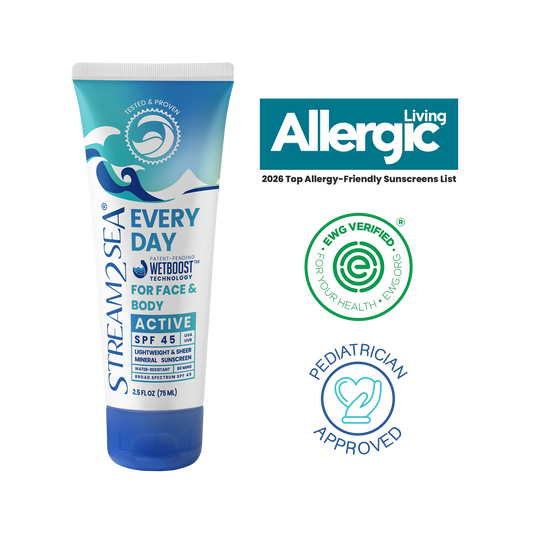
If you want a place to start, our Coral Care SPF 30 is the formula independent researchers at the University of Derby found could support coral growth by up to 29%, and our Every Day Active Mineral Sunscreen is patent-pending, non-whitening and the one our advocates reach for on land and in the water. You can see how we test everything we make on our Science and Standards page, and browse the full lineup of mineral sunscreens here.

Bemotrizinol is a real step forward for sunscreen science, and we will keep watching the research the moment there is something new to say. We are not here to tell you to fear it or to trust it. We are here to read the evidence carefully and change our minds when it earns it. We are so glad to have you reading along with us.
Sources & Further Reading
- Bemotrizinol Environmental Assessment: DSM-Firmenich, submitted to FDA as part of OTC monograph order OTC000039. Environmental_Assessment.pdf
- Human Exposure / Breast Milk Detection: Sun et al., "Widening the Lens on UV Filters: Newfound Ubiquity of Triazine UV Filters in Breast Milk from South China and Implications for Augmented 'Cocktail' Exposure in Infants," Environmental Science & Technology Letters 2022, 9(10), 844–850. View on ACS Publications
- FDA Approval: "FDA Expands Sunscreen Options for the First Time in 20 Years," June 9, 2026. View FDA announcement
- Stream2Sea Standards: Reef Safety Tests & Science